

Travel and Camp on Durable Surfaces

A nation that destroys its soils destroys itself. Forests are the lungs of our
land, purifying the air and giving fresh strength to our people. |
 When I visit the wilds, my goal is to experience the environment without altering it. I realize my goal is an impossible reality, but still something to which I can strive. Even if I am only on a day-hike, using no fire, no camping, and not even a toilet break, my footsteps and simple presence have a small impact on the inhabitants and their home.
I do have choices on where that impact occurs and how severe it is. The most obvious one, and the one that occurs no matter the length of the trek, is the decision of where to place your feet. Being aware how travel, rest breaks, and campsites cause impact is a critical step in approaching minimal impact.
Durable Surfaces
There are many different surfaces on which to travel. Choosing the most appropriate one available will help minimize the evidence of your travel.
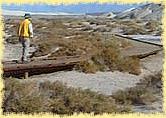 Asphalt, cement, crushed gravel, boards - artificially created paths and camping spots are the most durable and appropriate surfaces. Use established trails whenever possible and set up your tent in a provided campsite.
You will find planned, groomed trails in most high traffic areas. In popular wilderness areas, trails have been 'naturally' created by years of hikers. Some of them are enhanced by the land management agencies while others are self-maintaining due to constant traffic.
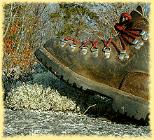 Rock - highly durable and able to withstand repeated traffic. But, if you've ever seen steps in old buildings in Europe, rock too will wear away in time. Keep an eye out for lichens and mosses living on the rock. These small plants are fragile and easily crushed between boot and solid rock.
Rock may also be slippery, especially in early morning or in shade. Metal hiking poles are prone to leave scratches on rock and vandals are often tempted to draw on them.
Since trails can be very difficult to notice on rocky terrain, cairns sometimes litter the landscape - read more about rock cairns.
A large flat rock surface works fine for a campsite also.
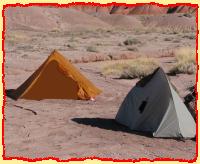 Sand, Gravel - very durable but also softer than rock. Footprints are left behind, but since these surfaces are fairly sterile vegetation is not destroyed. Walking on sandy beaches below high tide or in dry washes is a great way to have your tracks erased.
Sand is a good surface for camping as long as you are well away from water source and flashflood danger. If a thunderstorm were to happen in the hills above these tents pictured, they may get washed away along with their tracks.
Crushed gravel used on groomed paths is a good walking surface. Natural gravel is rarely that consistent and twisted ankles are a possibility as the size of rocks increases.
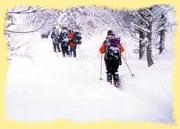 Water - whether in the form of snow, ice, or liquid water, H20 makes for a really cool way to travel with no lasting trace. Tracks left in snow will melt quickly during summer or be covered by more snow if traveling in winter. Traveling by canoe or kayak leaves no trace in open water.
Take care that the snow cover is sufficiently deep to protect the possibly soft ground underneath, especially in spring and fall and along edges of snowfields.
There's no problem setting up your tent on snow. You can flatten the snow surface just like sand and an insulating groundpad will keep you warm.
 Vegetation -
The last choice to place your feet is on living vegetation. But, even then, there are some choices better than others.
Vegetation -
The last choice to place your feet is on living vegetation. But, even then, there are some choices better than others.
- Dry Grasses - Grasses in drier areas are quick to recover from some traffic.
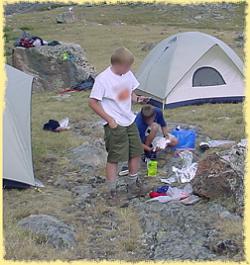
If the grass is dead, then your impact will remain for the season, but the next growth will erase it. Some places may allow you to camp on flat dry grass area and still have rock on which to cook and sit. These campers have their packs on a rock in the background and are cooking on a rock area. There is even a person in a white shirt waaaay in the background relaxing on a large rock.
Green grass is more easily damaged, but is still more resilient than other vegetation.
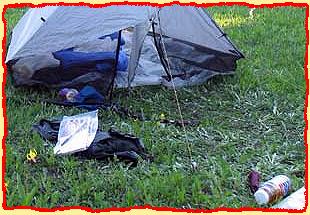 Soft-leaf Plants - the least durable ground cover. When you walk through ferns, flowers, herbs, and other fragile vegetation, just a few steps destroy those plants.
They look nice and comfortable for your tent, but the ground is just as uneven and the impact you create is noticable after only a few minutes.
That impact will remain for days, enticing others to use the same location and further impacting the site.
Take care to avoid all vegetation that appears fragile.
- Dry Grasses - Grasses in drier areas are quick to recover from some traffic.
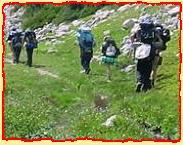 Wetlands - Fragile plants and grasses often grow in moist areas. If you seen lush, green cover, that is a good sign to avoid walking through that area. You'll crush plants and probably get muddy feet.
Once a trail is created and you are following it, you should take the responsibility to stay on that trail. If it goes through some mud, then go right through the mud with it. Don't skirt the mud to keep your cute boots nice and clean because that just tramples more plants and widens the trail or creates a web of trails over time.
Here is an extreme example of a high-traffic trail going through an area that becomes muddy at times. People have created at least 6 trails in parallel and they have not had time to recover and disappear.
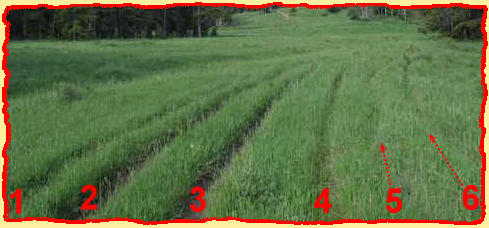
High-Use versus Pristine Choices
The most complicated part of making choices when attempting to minimize impact is deciding when to concentrate impact and when to disperse impact. As long as you are thinking about how to keep the area as natural as possible, the decisions are pretty easy. But, there will be some fuzzy grey areas where you decision might not match someone else's.
Concentrate Impact - nearly all the time, you should concentrate your impact in established areas. That means use existing trails and established campsites. If it is obvious that a place is being used already, you will affect no new space by concentrating your activity in that area.
Many areas have designated campsites, the Boundary Waters Canoe Area in Minnesota for example. You are required to use those sites and if one is occupied, you must travel until you find an open one. Other places may allow camping anywhere, but that doesn't mean you should camp anywhere. Any area that gets much traffic will have numerous and fairly obvious campsites - use one that already exists.
If you can tell a trail is a shortcut or inappropriate route, then stay on the correct trail. If a campsite looks like it is too small for your group, find a larger one.
Disperse Impact - you will rarely need to disperse your impact. Pristine wilderness areas are remote, undisturbed and very fragile. There is no indication of previous explorers which means no trails to follow or campsites to use. For most people, this is the escape they want to experience when they go backpacking. Unfortunately, we have historically invaded these areas with no concern for future explorers looking for similar experiences. In these areas is where the ethic of minimizing impact is most important to use - not to practice, but to use. Before exploring areas with no established trails, you should be completely rehearsed in how to leave no trace and confident you will follow these principles.
Impact should be dispersed whenever there is no existing trace. You should still choose the most durable surfaces, but spread out your impact as much as possible.
Campsite Choices
While hiking, you are only impacting a spot for a few seconds. You step, crush, and move on. If you have others with you, then the impact is repeated, but is still for only a short time.
When you stop to rest, you may impact that spot for up to a half hour. Rest stop impacts are more damaging because you plop your pack on the ground, mill around looking for snacks, stretch your legs, maybe drop scraps of food, and go pee. Choosing an appropriate spot to rest is an important choice.
Even more important is to select the best possible location for your evening campsite. You will be setting up home here for more than half a day. During that time, you will use the restroom, wash up, cook food, take out the garbage, relax, and explore. You may put more pressure on this one place than you did on all your hiking throughout the day.
Good campsites are found, not made.
Tips on Using Durable Surfaces:
- Camp at least 200 feet from water sources and well off the trail. This gives you privacy and protects the water from contamination. It also helps allow wildlife access to water.
- Know and follow local regulations to ensure your plans for travel and campsite selection are within the rules. Leave No Trace principles are ethical guidelines, not rules. But, many popular areas have put legal regulations in place to help protect against unknowing or uncaring individuals.
- End your day of travel early so you have time to properly select a campsite. Being tired, or running late, or encountering bad weather are not good excuses for inhabiting a fragile location for your campsite.
- For established campsites:
- If there are multiple sites from which to choose, use the one that best fits your group. Don't take a big site, forcing a larger group to crowd into a small site and impact its edges.
- Choose the most heavily-impacted site - all vegetation worn away, exposed rocks.
- Set up your tents and cooking in the center of an existing site. Keep traffic confined as much as possible to the area already trampled. Don't put your tent on the grassy area over on the edge, let it grow while your tent sits on the dirt.
- When you pack to leave an established site, take time to clean it up, including removing ashes, packing out other users' trash, and possibly taking apart structures and extra firerings.
- In pristine space:
- If you notice a place that looks great, but has traces of prior use, keep looking and let it recover.
- Set your tents up a ways apart to distribute the footprints
- Place your cooking area on the most durable location. It gets the most traffic.
- Wear soft shoes around camp, mocassins make much less of a track than a hiking boot.
- Plan your traffic to minimize unneeded walking. When you stow your pack, get everything you'll probably need for the evening so you don't need to walk back to get your toothbrush, then your flashlight, then your washcloth, ...
- Take a different route every trip you make to disperse your foot steps. If there is an obvious, durable path, use that - stepping rock to rock, for example.
- Use your backpacking stove and do without a campfire.
- When leaving your site, rake matted grass up with a stick, brush out noticable footprints, and restore the area to as natural a state as possible. You do not want anyone to see you were here and use it again.
Using Durables Surfaces is Important because it:
- minimizes the impact you make, both while traveling and camping
- takes advantage of the impact done by others
- improves the experience for people visiting after you leave
- keeps more of the land in its natural state
- ensures you are taking steps to Leave No Trace
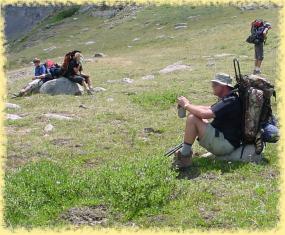
These backpackers are taking a break. They have moved off the trail and are each finding their own spot to rest. Notice they are sitting on very durable rocks rather than on the grass.
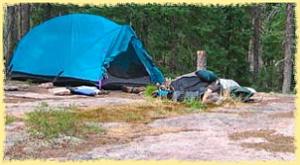
Setting up camp on a large flat rock leaves minimal impact.
This site in a pine forest has had the lower spots on the rock filled with pine needles over time. There is also plenty of room for a cooking area. There is little chance of leaving an impact here.
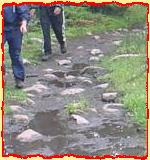
When a trail is present, its important to use the trail.
By wearing waterproof boots, you can walk through mud down the center of the trial, not skirt it to keep your feet dry.
This trail is becoming wider due to pampered hiking boots.
 The most common concern people have with this principle of Travel and Camp on Durable Surfaces is the uncertainty of when to concentrate impact and when to disperse.
In well-traveled areas, the choice is easy and there are usually well-used paths and campsites. In pristine areas, you may encounter people that feel hikers should stay in single file to minimize the amount of area impacted. This is sometimes appropriate, for example if there are rocks to step on rather than have each person on a different route trampling plants and grasses.
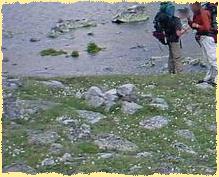
Rock Hopping is one of my favorite games. In a field like that pictured here with plenty of bare rocks visible, I like to step from rock to rock and see how far I can travel without touching grass or flowers. If lichens are growing on the rock, walking on the grass is a better choice.
Teaching Travel and Camp on Durable Surfaces
- General Teaching Advice - good ways to get people to learn
- Activity - What is Durable?
- Activity - Disperse or Concentrate
- Activity - Campsite Placement
- Activity - Campsite Selection